A modern vehicle is a complex combination of mechanical, electronic, and software systems. That is why high-quality diagnostics today can no longer be limited to simply reading fault codes with a computer. A fault code only indicates the direction, while the real problem often lies deeper – in sensor signals, wiring, control unit communication, mechanical engine processes, or the interaction between different systems.
Diagnet™ specializes not only in computer diagnostics, but also in oscilloscope diagnostics – a more advanced diagnostic method that allows us to see real electrical signals, their shape, stability, synchronization, and deviations from normal operation.
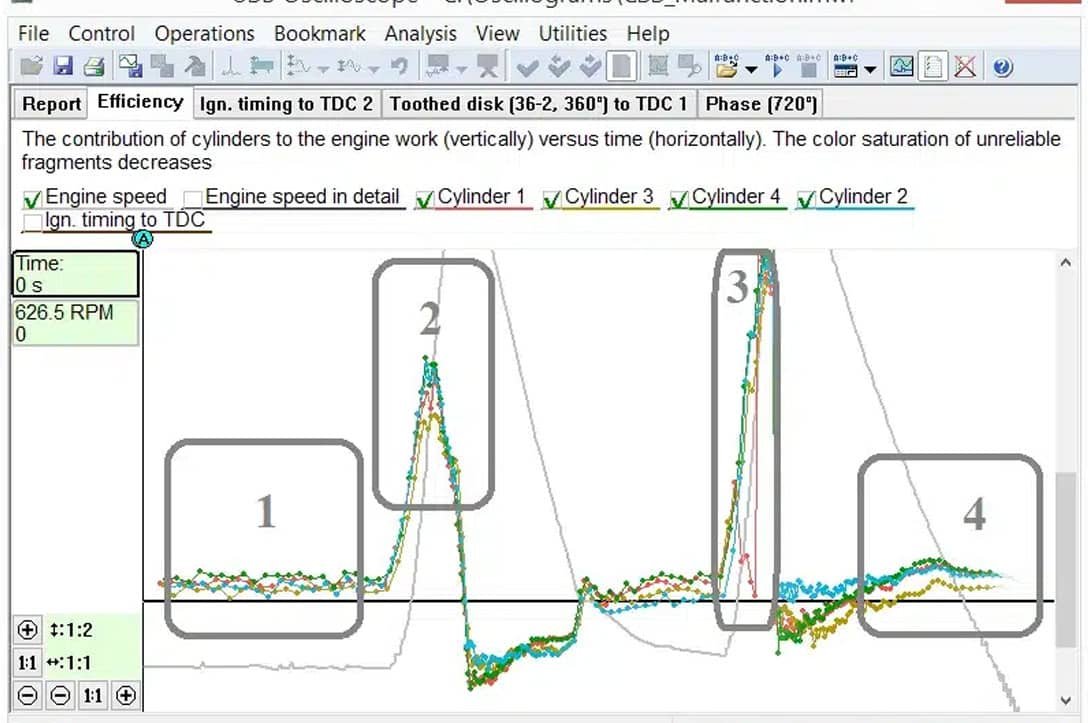
Oscilloscope diagnostics is the testing of vehicle systems using an automotive oscilloscope. Unlike a standard diagnostic tool, which displays fault codes and parameters, an oscilloscope allows us to see the actual signal in real time.
This is especially important when:
An oscilloscope allows us not to guess, but to see factual data.
In many workshops, diagnostics is often understood as simply reading fault codes. However, a fault code does not always mean that the exact component mentioned in the fault should be replaced. For example, faults related to air flow, pressure, EGR, DPF, injectors, or synchronization may be caused by a completely different issue.
The USB Autoscope diagnostic library also emphasizes that, in a modern vehicle, it is not enough to rely on fault codes alone – it is necessary to understand the processes, check cause-and-effect relationships, and analyze real signals. A fault code is only the beginning of diagnostics, not the final answer.
Therefore, professional diagnostics must answer not only the question “what fault is present?”, but also the most important question – “why did this fault occur?”
Using oscilloscope diagnostics, many vehicle systems and components can be checked. This is especially useful when diagnosing complex, recurring, or unclear faults.
We can analyze:
The USB Autoscope library provides examples of signals, sensors, actuators, ignition systems, and advanced fault diagnostics, including oscillograms, video material, and practical diagnostic scenarios.
One of the biggest advantages of oscilloscope diagnostics is the ability to assess the mechanical condition of the engine without unnecessary disassembly. Pressure sensors, relative compression tests, and special analysis methods can be used for this purpose.
This makes it possible to assess:
The USB Autoscope diagnostic methodology describes tools and scripts for diesel engine analysis: ElPower – for assessing starting, battery, starter, and generator performance; CSS – for cylinder balance, CKP/CMP synchronization checks, injector signal analysis, and pressure curve evaluation.
Many modern faults are not related to the component itself, but to its signal, power supply, ground, or communication. Therefore, an oscilloscope allows us to see what a simple diagnostic scanner cannot show.
It is possible to identify:
This is especially useful when a vehicle has intermittent faults that occur only under certain conditions – with a cold engine, when warmed up, while driving, during vibration, or under load.
Oscilloscope diagnostics is useful not only for passenger vehicles. It is also very important for trucks, buses, construction machinery, agricultural machinery, and other heavy-duty equipment, where faults are often related to sensors, wiring, control units, CAN communication, or actuators.
USB Autoscope materials on heavy-duty machinery diagnostics emphasize that modern heavy-duty equipment depends on clean, stable, and precisely synchronized electronic signals, while an oscilloscope makes it possible to test sensors, CAN buses, actuators, microprocessors, and control modules.
Therefore, this method is especially valuable when equipment downtime is expensive and the cause of the fault needs to be identified quickly and accurately.
In Diagnet™ diagnostics, the main goal is not to replace as many parts as possible, but to accurately identify the cause of the fault. Therefore, we carry out diagnostics systematically: from fault code reading and live data analysis to measuring real signals with an oscilloscope.
Our approach:
This helps reduce the risk of unnecessary parts replacement and saves the client time and money.
It is worth contacting Diagnet™ when the cause of a vehicle fault is unclear, faults return after repair, or you want to know the exact problem before replacing parts. We perform not only computer diagnostics, but also real signal analysis with an oscilloscope, allowing us to assess the operation of vehicle systems more accurately.
We can help if:
Contact Diagnet™ at info@diagnet.lt – we will perform professional computer and oscilloscope diagnostics, check real signals, and help accurately identify the cause of the fault.